
How Ready Is Your Staff to Respond When Behavior Escalates? A Readiness Checklist
A paraprofessional helps a student who is shouting in the hallway find a quiet place to calm down. A bus driver notices a rider getting agitated and steps in before an argument turns into a fight. A teacher stays after the bell with a student who had an outburst in class.
School staff show up for students in moments like these every day.
But care alone can’t prepare staff for every difficult moment. Escalating behavior, mental health needs, and trauma can quickly turn into a crisis. Without the right training and practice, even deeply committed staff may be unsure how to respond safely.
That raises an important question for school and district leaders: Do staff across every role have a consistent, safe way to respond when behavior escalates?
Understanding where your team is prepared, and where they may need more support, is the first step towards safer, more supportive schools.
Is your district prepared for difficult moments?
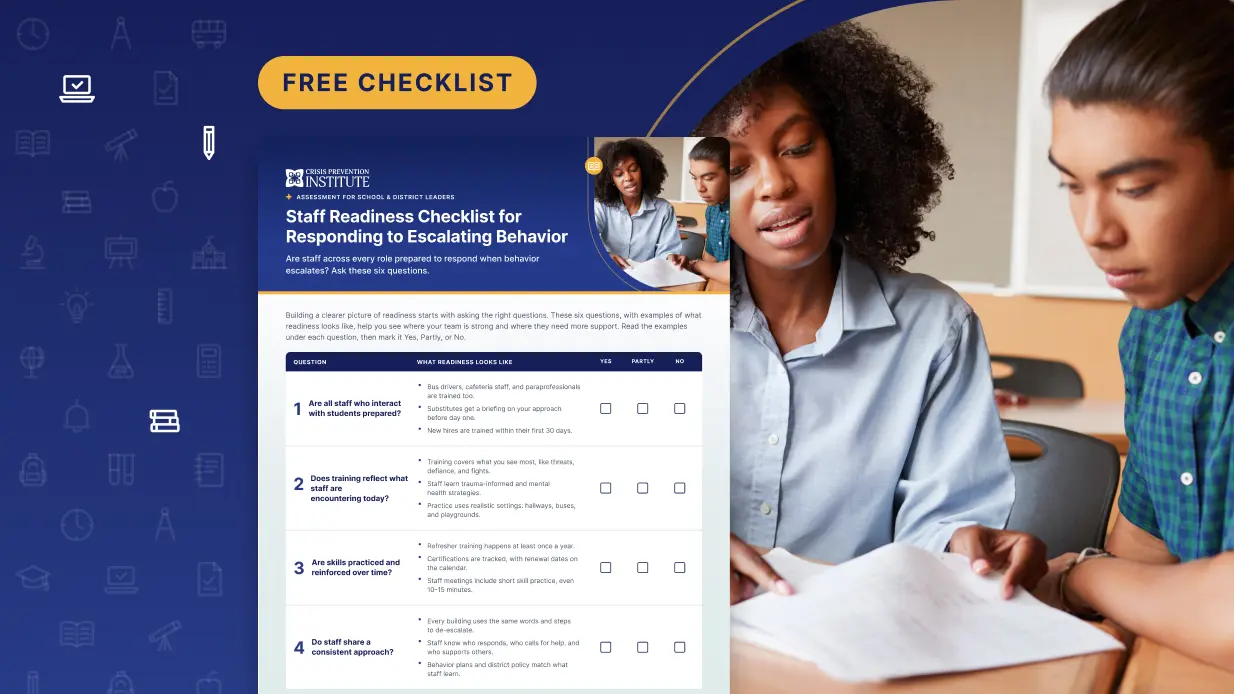
Download the Staff Readiness Checklist to identify strengths, uncover gaps, and determine where your team may need additional support.
Assess Your Readiness
What’s Showing Up in Schools Today
The challenges facing school staff have changed. Training and support may not always have kept pace. Schools are navigating:
- Students struggling to regulate strong emotions
- Physical aggression, including fights and assaults on staff
- Students with mental health needs or trauma histories
- Behavior-related disruptions that take time away from teaching and learning
And these challenges don’t affect classroom teachers alone. Paraprofessionals, bus drivers, cafeteria teams, substitutes, and front- office staff may all encounter difficult behavior, yet their levels of training and preparation can vary significantly.
Where Readiness Gaps Can Hide
Every school faces different challenges, and every team starts from a different place. Readiness gaps aren’t about how much staff care or how hard they’re trying. Often, they come down to who receives training, how often skills are reinforced, and whether that training reflects what staff face today.
Not Every Role Is Included
Training often focuses on teachers or special education staff. But paraprofessionals, substitutes, bus drivers, front office staff, and other support staff also interact with students. They need the same skills to recognize and respond to escalating behavior.
New staff can miss out, too. Staff who join midyear may have to wait for the next scheduled training. That can leave them less prepared than their colleagues.
Training Isn’t Reinforced
A single training session can introduce important skills. But without practice, those skills can be hard to recall when a difficult moment happens. When busy schedules push refresher training aside, staff may lose confidence or respond less consistently.
Regular refreshers also help keep training current, so staff are ready for what they face today, including escalating behavior, trauma, mental health needs, and physical aggression.
Approaches Differ Across Teams and Buildings
When buildings or roles use different language, expectations, or strategies, students may experience inconsistent responses throughout the school day. A shared approach helps staff respond with greater consistency.
Closing these gaps starts with recognizing where they exist. From there, leaders can build a consistent approach that gives staff the skills and confidence to respond when it matters most.
Signs Your Team May Need More Support
Readiness gaps aren’t always obvious. Often, they show up first in incident data, staff feedback, and day-to-day interactions.
Look for patterns such as:
- Repeat incidents: The same students, settings, behaviors, or times of day repeatedly appear in incident data.
- Staff injuries: Employees are getting hurt while responding to escalating behavior.
- Rising suspensions and referrals: More students are being removed from learning environments following behavioral incidents.
- Low staff confidence: Employees say they aren’t sure how to respond when behavior escalates.
- Burnout and turnover: Difficult or unsafe situations are contributing to staff stress and strain.
- Inconsistent responses: Staff members respond to similar behaviors in very different ways.
If several of these patterns sound familiar, it may be time to take a closer look at whether your team’s preparation matches the situations they’re being asked to manage.
Six Questions to Ask About Staff Readiness
Building a clearer picture of readiness starts with asking the right questions. Use these six prompts to identify where your team is well prepared and where additional support could make a difference.
- Are all staff who interact with students prepared? Does everyone who interacts with students have the skills they need to recognize, prevent, and respond to escalating behavior? Consider paraprofessionals, bus drivers, substitutes, front office teams, and other support staff alongside classroom educators.
- Does training reflect what staff are encountering today? Does your training address the behaviors, mental health needs, and trauma-related challenges staff encounter in your schools?
- Are skills practiced and reinforced over time? Are refreshers built into your training plan? Do staff have opportunities to practice and reinforce skills between formal training sessions?
- Do staff share a consistent approach? Do staff across roles and buildings use common language and strategies? Does everyone understand their role when a situation escalates?
- What happens after a difficult incident? Are there opportunities to debrief after incidents, learn from what happened, and support staff well-being?
- Are you using data to identify your greatest needs? Are you tracking incidents, injuries, suspensions, and other relevant data and using those insights to guide training decisions?
Download the Staff Readiness Checklist to identify strengths, uncover gaps, and determine where your team may need additional support.
Download a Shareable Copy of the Staff Readiness Checklist
What’s Possible When Skills Match the Heart
When staff have both the desire to help and the skills to respond, schools can create a more consistent approach to preventing and responding to challenging behavior.
School District U-46 in Illinois offers one example. As physical aggression and fights increased across the district, leaders implemented CPI training to establish a shared approach to responding effectively.
The district reported:
- 90% reduction in assaults on staff in the first year
- 75% reduction in out-of-school suspensions over five years
As John Heiderscheidt, Director of School Safety and Culture for School District U-46, shared:
“We have seen the number of fights as well as student-on-student conflict reduced. We have had staff report that the techniques have helped them with difficult situations. We have been able to gain consistency in the implementations of these techniques in order to reduce the further growth of a crisis event."
Find the Right Path Forward
Your staff already bring the care, commitment, and desire to help students succeed. The next step is making sure they also have the skills, confidence, and shared approach to navigate difficult moments safely.
Start by understanding where your team stands today, then use those insights to build the support they need for what comes next.