Funding and Grant Opportunities: A Guide for Education Leaders

Educators juggle endless responsibilities, but one priority must stay clear: ensuring students feel physically and emotionally safe. However, building that foundation requires resources, and as every education leader knows, budgets are often tight.
District and school leaders need clear insight into which federal and state grants can help meaningfully strengthen safety, support, and instructional quality. As you navigate the complexities of budget planning, these federal and state funding opportunities will help support student and staff success in 2026 and beyond.
Federal Funding Opportunities for Schools and Districts
Federal revenue sources are often the backbone of supplemental funding for schools. Understanding the specific purposes and uses of these major titles can help you align your district’s needs with the right funding sources.
Title I: Improving Academic Achievement
Title I is the largest federal aid program for public schools in the United States. It provides financial assistance to local educational agencies and schools with high numbers or high percentages of children from low-income families. The goal is to ensure that all children meet state academic standards.
Key Uses for Title I Funds:
- Strengthening core instruction: Investing in high-quality curriculum and instructional materials that support academic achievement.
- Professional development: Providing teachers and staff with training on evidence-based instructional strategies and classroom management techniques.
- Academic support: Funding tutoring, after-school programs, and summer learning opportunities to help students catch up.
- Schoolwide improvements: Implementing comprehensive reform strategies that upgrade the entire educational program in a Title I school.
IDEA: Supporting Special Education
The Individuals with Disabilities Education Act (IDEA) funds are specifically designed to support the education of children with disabilities. These funds ensure that eligible children receive a free public education that emphasizes special education and related services designed to meet their unique needs.
Key Uses for IDEA Funds:
- Professional development: Training for general and special education teachers in inclusive practices and how to support students with diverse learning needs.
- Behavioral supports and interventions: Implementing programs like Positive Behavioral Interventions and Supports (PBIS) to create a supportive classroom culture.
- Compliance and risk reduction: Funding activities that ensure legal compliance.
Investing IDEA funds in staff training is particularly effective. When educators see behavior through the lens of neuroscience, they better understand how stress affects the brain and body, allowing them to implement more inclusive and supportive classroom strategies for students with disabilities.
Title II, Part A: Preparing, Training, and Recruiting High-Quality Teachers and Principals
Title II, Part A provides grants to state and local educational agencies, as well as for higher education and eligible partnerships. The purpose is to increase student academic achievement by improving teacher and principal quality.
Key Uses for Title II, Part A Funds:
- Improving school leadership: Providing professional learning opportunities for principals and superintendents to enhance their instructional leadership skills.
- Supporting staff: Extending professional development to paraprofessionals and other support staff who play a vital role in the school ecosystem.
- Safe environments: Developing programs that foster safe, healthy, and inclusive learning environments, including training on de-escalation and trauma-informed care.
Title IV, Part A: Student Support and Academic Enrichment
The Title IV, Part A grant is a flexible block grant intended to improve students’ academic achievement by increasing the capacity of states, local educational agencies, schools, and local communities to provide all students with access to a well-rounded education, improve school conditions for student learning, and improve the use of technology.
Key Uses for Title IV, Part A Funds:
- Well-rounded educational opportunities: Supporting programs in music, arts, STEM, and accelerated learning.
- Safe and healthy students: Funding initiatives that foster safe, healthy, supportive, and drug-free environments. This includes mental health services, bullying prevention, and de-escalation training.
- Effective use of technology: Increasing access to personalized learning experiences supported by technology and professional development for educators using data and technology to improve instruction.
Districts can use Title IVA to strengthen safety initiatives, including staff training that helps educators manage everyday classroom challenges with confidence.
Navigating State-Level Grant Programs
While federal funds are substantial, state-level grants often target specific, timely issues facing schools in your region. These can be excellent sources of funding for safety upgrades, mental health initiatives, and specific educational programs.
Identifying State Opportunities
State grants vary widely, but they commonly focus on current legislative priorities. Recently, many states have released funding specifically for:
- Safety and security: Grants for physical security upgrades (cameras, locks) as well as soft security measures like threat assessment training and crisis response planning.
- Mental health and social-emotional learning (SEL): Funding to hire school counselors, psychologists, or social workers, and to implement SEL curricula or trauma-informed care training.
- Violence prevention: Grants aimed at reducing school violence through evidence-based programs, anonymous reporting systems, and community partnerships.
To find these opportunities, regularly check your state Department of Education’s website and subscribe to their grant notifications. Additionally, networking with other district leaders can provide early intelligence on upcoming funding streams.
Your Guide to Education Funding
Supporting students begins with the right resources. Download our one-page guide for federal and state funding to help your school district thrive..
Download the One Sheet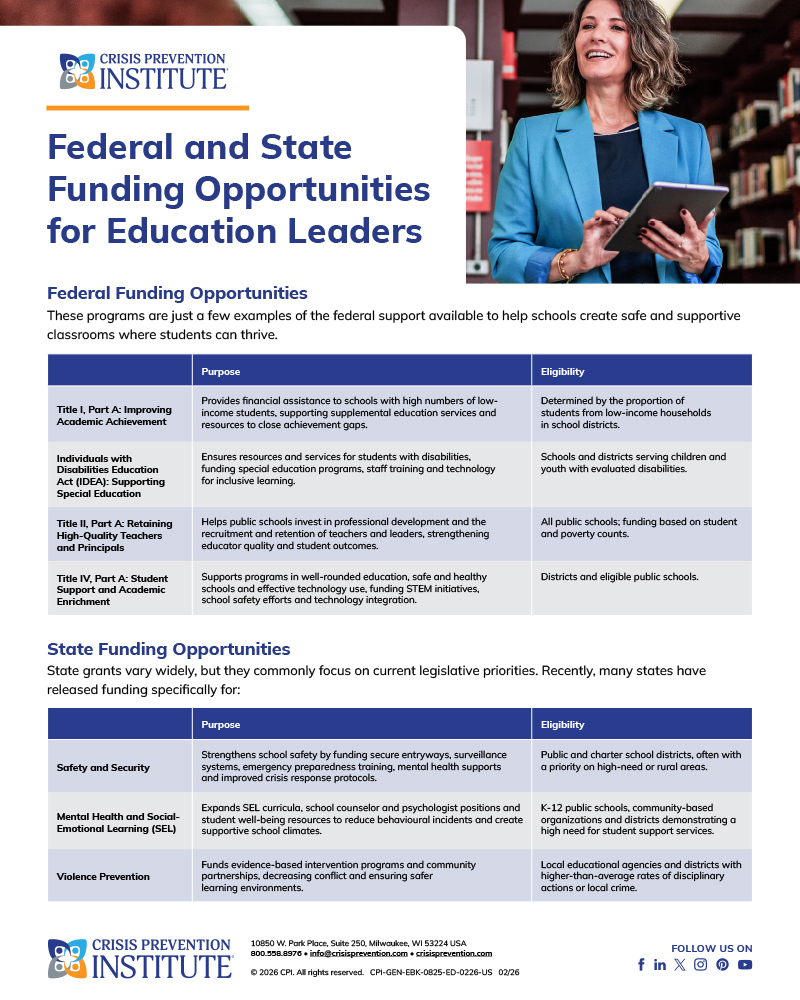
Investing in a Safer Future
Securing grants is the first important step, but true success lies in how you integrate these funds into a cohesive, long-term strategy that builds a safer and more supportive school environment. By investing in staff training—such as CPI’s de-escalation training and social-emotional learning initiatives—you lay a sustainable foundation for both student and staff success.
Prioritizing professional development empowers educators to manage challenging behaviors with confidence, promotes calmer classrooms, and frees up more time for teaching and learning.
As you finalize your budget, remember that funding decisions shape the well-being of your schools and community. Aligning grant opportunities and investments with your district’s long-term goals helps create an environment where educators and students can succeed.