Townsville Hospital: Reducing High-Risk Restrictive Practice
Find out how Townsville Hospital and Health Service scaled CPI training to manage most aggressive incidents without restraint, and significantly reduce prone restraint across a complex healthcare environment.
Impact of CPI Training
- Less restrictive care at scale: Most aggressive incidents are now managed without physical restraint, even in a high‑acuity healthcare environment.
- Significantly reduced high‑risk restraint: Continued and marked reduction in prone restraint across organisation‑wide data.
- Consistent practice across services: Training at scale has reinforced shared expectations around least restrictive practice and proportionate response.
- Sustainable capability: Internal instructor capacity and ongoing delivery support long‑term embedding.
"CPI training has been instrumental in reducing restrictive practices while improving patient outcomes. The results speak for themselves."
Ross Nicholls, Clinical Nurse Consultant – Least Restrictive Practice
Situation
Townsville Hospital and Health Service (THHS) serves over 250,000 residents across diverse local government areas in Northern Queensland, including Townsville, Burdekin, Charters Towers and Palm Island. With over 6,600 employees and 21 facilities, THHS supports patients across a broad and complex healthcare system where staff may need to respond to aggression, distress, cognitive impairment, behavioural escalation and other high-risk clinical situations.
THHS has long prioritised least restrictive practice, recognising the clinical, ethical and workforce safety risks associated with restrictive interventions—particularly high‑risk restraint. Leaders needed a consistent, defensible approach across multiple services and settings, supporting staff to intervene early, respond proportionately and preserve patient dignity when behaviour escalates.
CPI programmes supported this approach across varied clinical contexts, including Safety Intervention™, Dementia Capable Care, Verbal Intervention and Clinical Holding. Over time, a shared focus on prevention and de‑escalation helped teams act earlier and more consistently, reducing escalation and avoiding restraint wherever possible.
Implementation
Why CPI: trauma-informed de-escalation and scalable rollout
THHS chose CPI to strengthen least restrictive practice with an evidence-based, trauma-informed approach that could be implemented consistently across a large and diverse health service.
The training equips staff with practical de-escalation techniques, trauma-informed principles and clear alternatives to physical restraint, supporting safer responses when risk escalates and reducing reliance on high-risk interventions.
This created a shared language and decision pathway for early intervention, helping teams apply least restrictive responses more consistently across different services and risk situations.
Importantly for sustainability, CPI’s train-the-trainer model enabled THHS to build internal capability and maintain ongoing delivery at scale as workforce needs and clinical contexts changed over time.
Building an internal instructor network
THHS has invested heavily in internal training capability to support consistent and sustainable delivery across the organisation. Since 2019, 8,137 participants have completed CPI‑related training, including new starters and annual renewals.
This delivery is supported by around 30 Certified Instructors, enabling THHS to maintain consistent standards, reinforce least restrictive practice and respond to the varied needs of patients, staff and services across a large health system. This internal capability also allows THHS to deliver the right CPI programmes to the right teams, at the volume required to sustain organisation-wide practice change.
Matching CPI programmes to clinical contexts
With this instructor-led model in place, THHS delivers multiple CPI programmes across the organisation to match different clinical contexts and risk profiles, including:
- Safety Intervention™ Foundation
- Safety Intervention™ Foundation, Advanced & Emergency
- Verbal Intervention
- Dementia Capable Care
- Clinical Holding
Annual delivery figures demonstrate both continuity and scale. In 2025, THHS trained 1,232 participants, with a further 424 participants trained in 2026 year‑to‑date, supporting ongoing capability across services.
Outcomes
75% of aggressive incidents managed without physical restraint
Based on organisation‑wide incident reporting over the most recent 13‑month period, THHS now manages around three‑quarters of aggressive incidents without any physical restraint.
This reflects the combined impact of CPI Safety Intervention™ and Dementia Capable Care training in supporting prevention, de‑escalation and least restrictive responses, even within a clinically complex and high‑acuity environment.
Prone restraint reduced to 2.13% of all restraints
Prone restraint now accounts for just 2.13% of all physical restraints across THHS (2026), reflecting a marked and sustained reduction over time. Earlier reporting showed prone restraint reduced from 38% to 22.6% in one year (Oct 2023–Oct 2024); updated organisation‑wide figures confirm this progress has continued and strengthened.
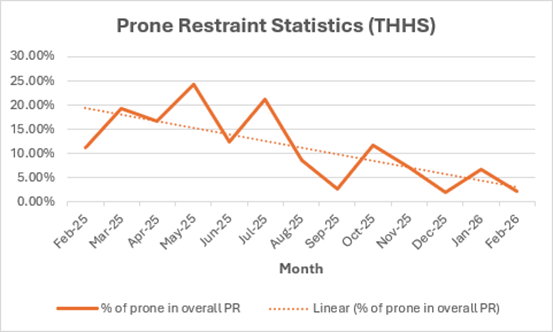
While the reporting scope has broadened beyond the original ward‑level focus, the direction is clear and consistent: THHS continues to reduce reliance on one of the highest‑risk forms of physical restraint. This indicates sustained control over the most restrictive interventions, even as patient acuity and service complexity evolve.
Reinforcing least restrictive practice, even when restraint is unavoidable
Crucially, this progress shows that when physical restraint is required as a last resort, staff are increasingly using the least restrictive options available, avoiding higher‑risk interventions wherever possible. This reinforces clinical safety, staff confidence and patient dignity across services.
“This is a tremendous statistic that demonstrates, even when physical restraint may be necessary as a last resort, that staff use the least restrictive means to achieve the purpose and avoid high risk restrictive interventions like prone restraint.”
Ross Nicholls, Clinical Nurse Consultant – Least Restrictive Practice
Future Perspectives
THHS is continuing to strengthen least restrictive practice with sustained CPI training delivery, internal instructor capability and ongoing review of incident and restraint trends to guide where support is most needed.
Future priorities include:
- Ongoing monitoring of restraint and prone restraint trends
- Reviewing incident data to identify targeted coaching or support needs
- Maintaining consistent, high‑quality CPI training delivery across services
Overall, the data points to durable change: training delivered at scale, most incidents managed without restraint, and prone restraint reduced to 2.13% across the organisation.
Consistent, least restrictive responses at scale
Embed early intervention and clear governance so teams de-escalate with confidence across every service.
Let's Connect