Trauma-Informed Care in Schools: Practices for Student Success
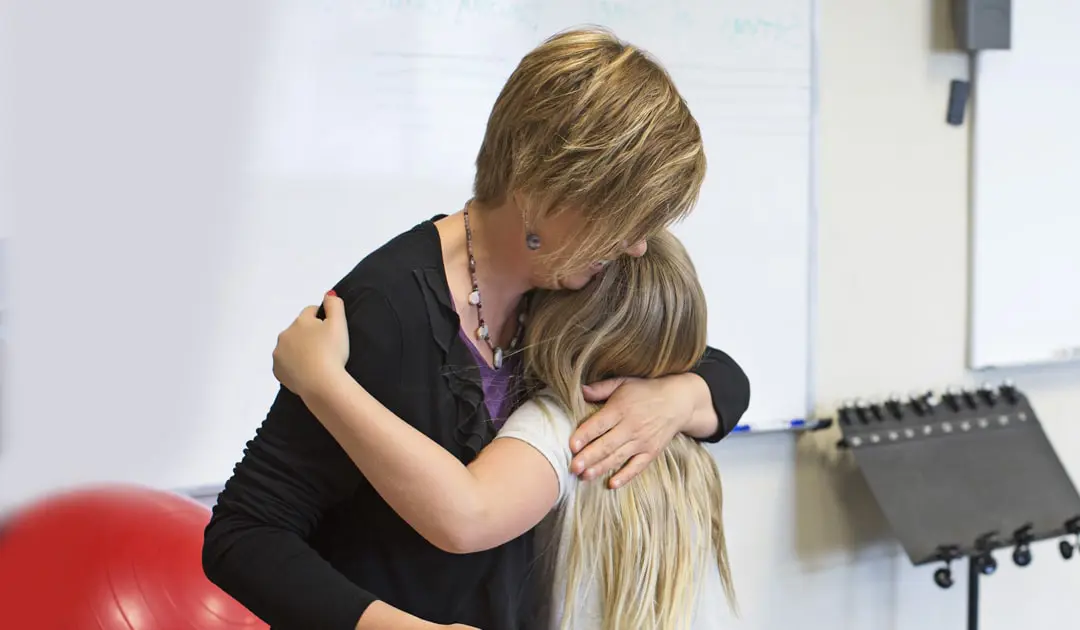
I want to explore the meaning beneath the statement behavior is communication. It’s a catchphrase that has been ringing in educators’ ears for a while now, finding its way onto the occasional t-shirt, coffee mug, and even posters hanging in the teacher’s lounge. Cognitively we certainly all understand this. But do we truly feel what behavior is communication means as we interact with our students all day long?
A Snapshot of What We Are Discussing
Behavior is communication: the principle that all behavior, especially challenging behavior, is a signal of an underlying need, emotion, or missing skill rather than simple defiance. When a child cannot yet put a feeling into words, the behavior says it for them. For educators, the work is to read that signal, regulate their own response, and address the need beneath the behavior. Crisis Prevention Institute (CPI) builds this principle into its de-escalation and behavior-support training.
A Lesson from Nellie.
Nellie is our rescue dog. Today she is a wonderful companion, but over her first 18 months of life we know Nellie experienced severe neglect and abuse.
As I walked Nellie one recent morning, I was reminded that many mammals, especially dogs, have communication systems that resemble ours at the emotional level. Put another way, they both embody lived experiences.
In Nellie’s case, past traumatic experiences live in her nervous system, and Nellie’s past becomes her present moment of communication. Anytime the doorbell rings, Nellie’s 45-pound body becomes rigid, her back hairs stand on end, and she begins growling and shaking. I think we can agree that her reaction is based on something that goes far deeper than behavior is communication. Nellie’s behavior is signaling profound fear. She does not look fearful; she looks scary!
Nellie is misunderstood, and her behavior is why she is misunderstood.
Past Experiences. Present Behaviors.
Humans also detect safety or danger through embodied past experiences. Those past experiences can bubble up and affect how we communicate and live in the present moment.
Tones and cadences of voices, gestures, and postures of humans can nonverbally create anxiety, dread or terror or signal safety in others. Early traumatic experiences can shift how we communicate with each other, and this is a two-way street as emotions are highly contagious. Anytime we are communicating thoughts and feelings, we carry into the conversation the states of our nervous systems. Whether we are communicating with a child, adolescent, or another adult, our attachment dynamics are present and observed. We communicate with one another in relational or detached attachment. Our behaviors are only the signals or indicators that provide clues to sensory or emotional states beneath the behaviors.
Yes, Behavior is Communication. But What’s Beneath the Behavior?
Attachment, when you peel the layers away, is the gravitational force that pulls us to one another so we can survive. Attachment is embedded in our nervous systems. When we only address the behaviors we observe in one another, we can liken this to placing a band-aid on an open wound in need of 30 stitches. If all behavior is indeed communication, then we need to address what lies beneath the behaviors, and our bodies often share the underbelly of our behaviors without thought or resistance.
If you want to know which way the wind is blowing, look at the sand. If we want to know how a child is feeling, look at her body.
I want to emphasize the body states and communication indicators of the adults who are receiving a variety of behaviors through embodied communication systems in the classroom.
The questions below will be helpful as we deeply reflect upon our nervous system states when confronted with dysregulated behaviors that may in fact be communicating pain-based behaviors. When we are intentional about exploring our own reactions (sensations, feelings, and thoughts) when dysregulated behaviors show up, we will meet our students in a state of regulation and our discipline practices will become relational, preventative, and brain-aligned.
- What is my behavior communicating to the student? What are my gestures, face, posture, and tone communicating?
- Have I checked in with my nervous system?
- Am I checking in with my authentic self? Authenticity is the state of being in touch with ourselves, so am I checking in with my gut feelings?
- Do certain students trigger me more than others?
- Are my responses to each student’s behavior the same?
- Which students do I redirect most often?
- What behaviors do they show?
- What behaviors do I expect to see?
- What emotion do I feel when certain students do not follow my directions?
- Which behaviors push my buttons most?
- What time in the day do I feel the most calm and happy with my students? (Silence, chatter, students listening to me speak, students speaking to each other)
- What time of day do I feel most dysregulated with my students?
- What is my definition of calm and connected students?
- Which students do I feel the closest to in my class?
- Why do I feel connected to them?
- Which students are my “favorites?” Why?
- Do I understand the cultural identity of my students? If not, what can I do to learn more?
- Do I attempt to make connections to my students’ culture and backgrounds in an authentic way?
- Do my students feel safe to be their authentic selves?
- Am I creating a community of inclusion and equitable access? (Everyone gets what they need- not the same thing for everyone)
- Do we have to make people feel bad to change their behavior?
The Functions of Behavior: What Challenging Behavior Communicates
If behavior is communication, the next question is what it is communicating. Educators and behavior specialists group most behavior into a few core functions. Naming the function turns a confusing moment into a solvable one, because the response changes depending on what the student is actually asking for.
Function |
What the behavior is communicating |
Escape or avoidance |
The student is trying to get away from a task, demand, or situation that feels too hard or overwhelming. Refusing to read aloud can mean the reading itself is the problem. |
Attention or connection |
The student needs a response, reassurance, or relationship. Calling out can be a request to be seen. |
Access to something tangible |
The student wants an object, activity, or outcome and does not yet have the skill to ask and wait. |
Sensory needs |
The student is seeking or avoiding sensory input. Pushing in line can mean a crowded space feels intolerable. |
Emotional regulation |
The student is expressing frustration, fear, or fatigue when the words for those feelings are not available. |
Most behavior serves one or more of these functions. The goal is not to label the child but to read the message, then teach the skill the behavior is standing in for.
How to Respond
Reading the signal is only useful if it changes how you respond. These steps move from noticing the behavior to meeting the need beneath it.
- Look beneath the surface: Treat the behavior as the visible tip of the iceberg and ask what need or feeling sits underneath it.
- Check your own regulation first: Your tone, posture, and breathing set the emotional temperature. A calm adult helps a dysregulated student return to calm.
- Validate before you redirect: Name what you see (“I can tell this feels frustrating”) before guiding the student toward a better choice.
- Teach the missing skill: If a student acts out because they cannot ask for a break or for help, teach and practice that skill directly.
- De-escalate, do not escalate: Lower your voice, give space, and avoid power struggles. CPI’s Crisis Development Model helps staff match their response to each stage of an escalation.
Responding this way is preventative. Each time a need is met and a skill is taught, the behavior has less work to do.
A Classroom Example
A student who repeatedly refuses to start independent work, then disrupts the group, may look defiant. Read as communication, the same behavior often says: this task feels impossible and I would rather be in trouble than look like I cannot do it. The response is not a louder correction. It is a quieter question about what support is missing, followed by the scaffold that lets the student begin.
Frequently Asked Questions
Is behavior a form of communication?
Yes. Behavior is a form of communication. Every action, especially challenging behavior, signals an underlying need, emotion, or missing skill, particularly when a person cannot express that need in words.
What are the functions of behavior?
Behavior usually serves one or more functions: escape or avoidance, attention or connection, access to something tangible, sensory needs, and emotional regulation. Identifying the function points toward the right response.
What are three things a behavior might be communicating?
A behavior often communicates that a student wants to escape a difficult task, is seeking attention or connection, or is trying to get something they want but lack the skills to request appropriately.
What is an example of behavior as communication?
A student who throws a book during silent reading may be communicating that reading feels too hard and they would rather get in trouble than be exposed. The behavior signals a need for support, not defiance.
Dr. Lori Desautels is an assistant professor in the College of Education at Butler University in Indianapolis, Indiana. Lori was also an assistant professor at Marian University in Indianapolis, where she founded the Educational Neuroscience Symposium, now sponsored by Butler University. Lori has created webinars for educators, clinicians, and administrators illustrating how educators and students alike must understand their neuroanatomy to regulate behavior and calm the brain. You can learn more about her work at Revelations In Education.
Schedule a Consultation
Learn how CPI’s training programs can benefit your organization.
Let's Connect