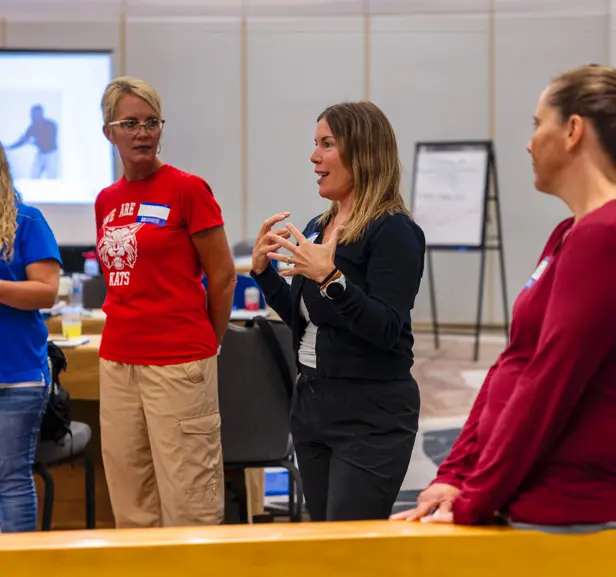
We certify your trainers
CPI Instructors train select staff to become your organization’s Certified Instructors.

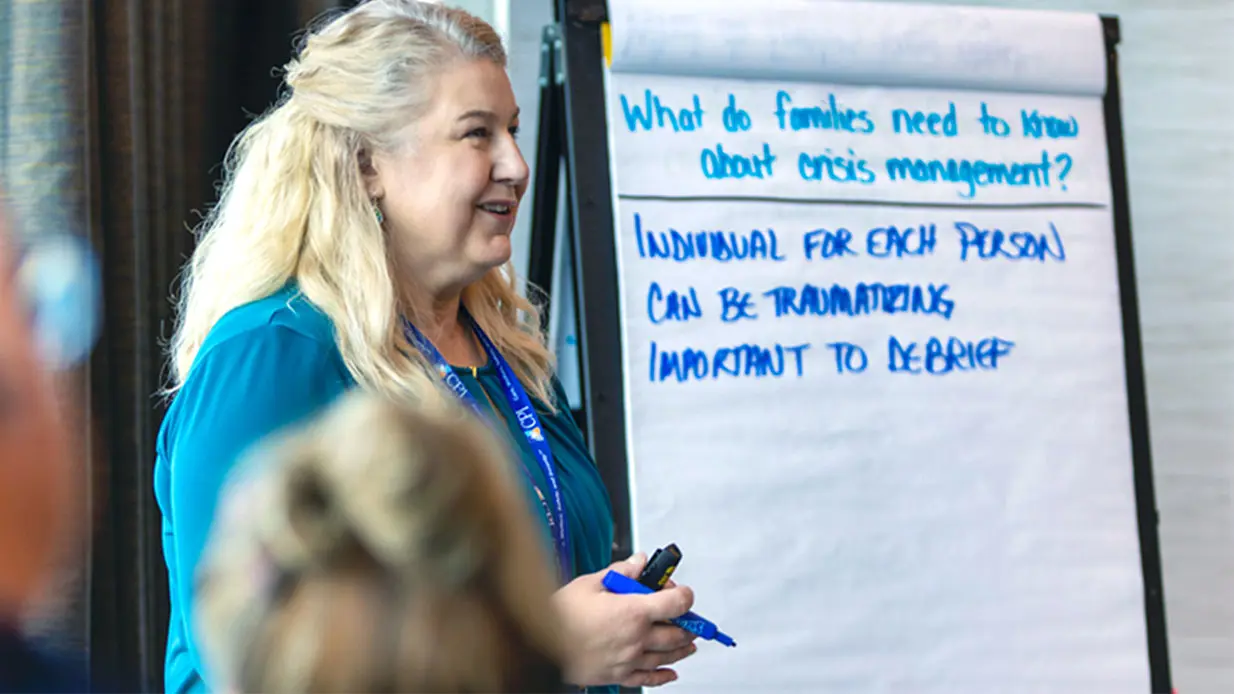
Our train-the-trainer framework certifies your staff to become de-escalation and crisis prevention experts, who teach and apply these new skills and behaviors to staff across your organization.
Our proven model allows you to customize your training based on roles and risk levels, ensuring the right staff receive the right training. And when staff have the training they need to feel safe and confident in the workplace, you increase your retention and job satisfaction rates.
CPI Instructors train select staff to become your organization’s Certified Instructors.
Certified Instructors conduct ongoing trainings using CPI courses and materials.
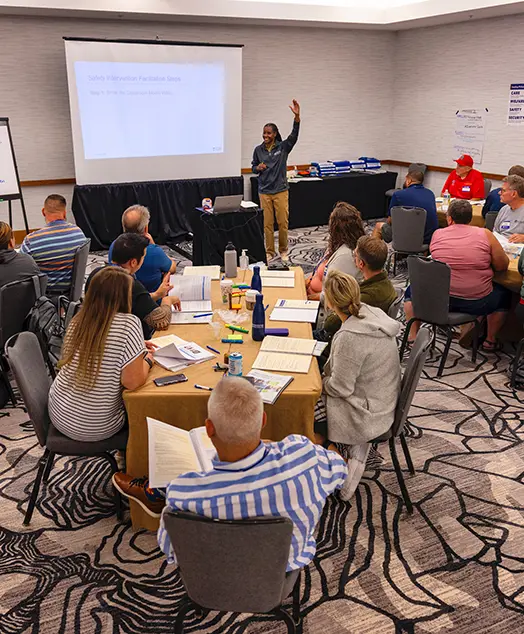
Trained staff gain practical expertise and vocabulary to safely address challenging situations.

Learning, coaching, and support from CPI continue even after you complete your certification. We offer guidance to your Certified Instructors with free refresher training, phone support for questions and concerns, and online resources.
Our Training Support Team is available to help problem solve any training issue, including how to:
Certified Instructors have exclusive access to online resources, including:
Joining our growing community of Certified Instructors provides access to:
CPI training is available in an array of formats to accommodate the needs of each organization.
The following recommendations from CPI help ensure your successful implementation of training, providing better cross-departmental collaboration, quicker and more efficient crisis response times, and increased staff confidence and retention.
CPI's train-the-trainer model works by certifying your organization's staff members as Certified Instructors who then conduct ongoing trainings using CPI courses and materials with their colleagues.
This approach ensures that training and related materials are easily customizable to meet the specific needs of your staff. The model incorporates practice, role-playing with real-life scenarios, and problem-solving activities to keep participants engaged throughout the learning process.
CPI's eLearning components are designed to be highly interactive and engaging, incorporating numerous learning strategies proven effective with adult learners.
This embedded approach makes it easy to roll out training organization-wide while allowing for organic change from within your organization, as your own certified staff members deliver the training using CPI's evidence-based methodology.
To become a CPI Certified Instructor, you must complete CPI's comprehensive train-the-trainer certification process. CPI Instructors train select staff from your organization to become Certified Instructors, enabling you to deliver evidence-based crisis prevention training internally.
The certification process typically includes several key components:
Prerequisites and Selection
Organizations work with CPI to identify appropriate candidates who demonstrate strong communication skills, teaching ability, and commitment to the training philosophy. Candidates should have experience working with the populations they'll be training and possess the interpersonal skills necessary to facilitate learning in potentially sensitive situations.
Instructor Certification Program (ICP)
Selected candidates attend an intensive ICP conducted by experienced CPI trainers. This program covers both the content knowledge and instructional methodology required to effectively deliver CPI training. Participants learn not only what to teach but how to teach it, including facilitation techniques, group management, and handling challenging training situations.
Program-Specific Training
Certification requirements vary depending on which CPI program you'll be teaching—whether Nonviolent Crisis Intervention®, Verbal Intervention™, or other specialized programs. Each has specific learning objectives and skill competencies that must be mastered.
Ongoing Requirements
Certified Instructors must maintain their certification through periodic recertification training to ensure they stay current with program updates and best practices. This reflects CPI's commitment to evidence-based methodology and continuous improvement.
The train-the-trainer approach allows organizations to embed crisis prevention skills organically within their culture while maintaining the integrity and effectiveness of CPI's proven methodologies. This model ensures sustainable skill reinforcement and creates internal expertise that can adapt to your organization's unique needs and challenges.
Yes, CPI training is evidence-based. The Crisis Prevention Institute is the world's leading provider of evidence-based de-escalation training.
CPI programs are built on scientific foundations and deliver measurable results across diverse organizations. Over 17 million individuals have been trained in CPI's evidence-based de-escalation techniques, creating demonstrable impacts on workplace safety. Organizations consistently report quantifiable improvements, including reduced staff injuries, decreased use of force, fewer classroom disruptions, reduced misconduct, and improved staff confidence.
This evidence-based approach ensures that CPI's crisis intervention and de-escalation skills are grounded in research and proven effective at reducing challenging behavior while preventing future incidents.
CPI training effectiveness doesn't depend on a specific minimum number of staff members being trained. Instead, the focus should be on comprehensive implementation across your organization.
We believe everyone has a role to play in creating a safer workplace, not just those in "high-risk" positions. Organizations that implement CPI training across their entire staff see significant benefits, including quicker and more consistent crisis responses, increased staff retention and job satisfaction, better cross-departmental collaboration and communication, and more effective training outcomes for Certified Instructors.
For optimal implementation, CPI recommends a 1:50 Certified Instructor to staff ratio, allowing each Certified Instructor to perform two, 25-person trainings each year. Additionally, establishing one Certified Instructor per building helps empower your staff and leads to quicker, more efficient crisis response times.
The key to effectiveness lies in selecting the right Certified Instructors, as they will have a significant impact on the overall success of your CPI training program. For organizations looking to implement foundational skills organization-wide, CPI offers specific training options designed for easy, comprehensive deployment across different industries and roles.
Organizations implement CPI training at scale through a structured train-the-trainer approach that builds internal capacity and ensures sustainable program delivery.
Select and Certify Internal Instructors
The foundation of scalable implementation is selecting the right Certified Instructors within your organization. These individuals will have a significant impact on the overall success of the CPI training program and are equipped with the principles and skills needed to effectively address crisis situations throughout your organization.
Follow Recommended Staffing Ratios
CPI recommends a 1:50 Certified Instructor to staff ratio, allowing each Certified Instructor to perform two, 25-person trainings each year. Additionally, establishing one Certified Instructor per building helps empower staff, leading to quicker, more efficient crisis response times.
Train Organization-Wide
Rather than limiting training to "high-risk" positions, CPI believes everyone has a role to play in creating a safer workplace. Organizations that implement CPI training across their entire staff see benefits through quicker, consistent crisis responses, increased staff retention and job satisfaction, better cross-departmental collaboration and communication, and more effective trainings for Certified Instructors.
Maintain Ongoing Training
Once certified, your internal Certified Instructors conduct ongoing trainings using CPI courses and materials. To ensure quality and prevent training drift, Certified Instructors are required to attend a CPI-facilitated program every two years.
This embedded approach allows organizations to build crisis prevention capabilities from within, ensuring training is sustainable, cost-effective, and culturally aligned with your organization's specific needs.
Yes, your organization can arrange on-site CPI training. We offer multiple on-site training options designed to accommodate your organization's specific needs and staff schedules while minimizing time away from daily operations.
Our on-site training delivery includes two primary approaches:
CPI Trains at Your Organization: A CPI Global Professional Instructor comes to your facility to work with your designated Certified Instructors to facilitate training.
Direct Delivery: If your organization doesn't have appropriate staff to serve as Certified Instructors, CPI will come directly to your organization and train your staff.
Additionally, we follow a train-the-trainer model where CPI Instructors train select members of your staff to become your organization's Certified Instructors. This approach allows training to be embedded within your organization's culture and enables ongoing skill reinforcement.
To explore on-site training options for your organization, you can schedule a consultation to discuss your specific needs and determine the best approach.
Organizations have achieved substantial, measurable results after implementing CPI training across multiple key areas.
Quantifiable Improvements:
Organizational Benefits:
Organizations implementing CPI training across their entire staff experience quicker and more consistent crisis responses, increased staff retention and job satisfaction, better cross-departmental collaboration and communication, and more effective training outcomes for Certified Instructors.
Specific Success Stories:
Notable achievements include a 90% increase in staff retention at Braun Educational Center, 18,000 staff trained at Duke University Health System, and an 85% reduction in safety interventions at Hillside of Atlanta.
Sector-Specific Outcomes:
Education: Reduced misconduct, fewer fights and assaults, improved staff understanding, enhanced student success, increased staff confidence, decreased classroom disruptions, and stronger positive peer-to-peer relationships.
Correctional Facilities: Decreased staff injuries, reduced compensation liability from injury claims, decreased use of force, and improved connections between staff and residents.
Health Care: Improved staff satisfaction, increased staff and patient safety, enhanced proactive communication techniques, better staff debriefing processes, and improved retention of quality staff.
Since 1980, CPI has helped train more than 17 million people in evidence-based crisis prevention and de-escalation techniques, creating sustainable impact across organizations worldwide.
Yes, CPI training is fully customizable for organizations. CPI training can be customized for all staff members in an organization regardless of their job description, role, or risk level.
CPI uses a comprehensive 4D approach to customize training for each organization's unique needs. This process includes four phases: Discover, Diagnose, Design, and Deliver. During the Discover phase, the CPI Professional Services team works with you to understand your goals and motivations. The Diagnose phase provides specific recommendations based on data and your unique needs. In the Design phase, CPI partners with key stakeholders in your organization to develop your implementation strategy, discussing technology implementation, direct delivery versus instructor certification, prioritization of training, training cadence, and logistics. Finally, the Deliver phase includes establishing your certified staff and delivering training to your staff.
CPI also gathers information about your industry, profession, and the specific behaviors you face to determine optimal training program options. You can select the CPI program that best aligns with your organization's needs, with options to enhance your training with trauma, mental health, and autism spectrum disorder content.
CPI training is available in multiple delivery formats to accommodate your organization's needs, including on-site training with your Certified Instructors, direct delivery where CPI trains your staff directly, or attending scheduled training events.
Yes, CPI training has demonstrated effectiveness across multiple educational settings with measurable outcomes that support its evidence-based approach.
Research from school districts nationwide shows consistent positive results. Scotland County School System in North Carolina and School District U-46 in Illinois both reported reduced fights and assaults following CPI training implementation. School District U-46 also documented reduced out-of-school suspensions alongside improved school culture.
Academic and behavioral improvements are well-documented across implementations. Scotland County experienced reduced misconduct and improved student success, while Wauwatosa School District in Wisconsin saw increased academic achievement and decreased disciplinary issues after training all 13 schools in Nonviolent Crisis Intervention®. Los Angeles County Office of Education and Sunrise School District in Missouri both reported significantly reduced classroom incidents and decreased classroom disruptions respectively.
Staff development outcomes demonstrate the training's comprehensive impact. Multiple districts reported improved staff understanding, increased staff confidence, and enhanced skills in managing behaviors. Trillium Family Services noted that CPI training equips staff with a common language for crisis response, while Braun Educational Center achieved the elimination of seclusion practices entirely.
Environmental and cultural improvements further validate the training's effectiveness. Organizations reported creating safer, more healing environments that support both student success and staff well-being. Improved student-staff relationships, boosted staff morale and retention, and enhanced school culture demonstrate the program's broad organizational impact.
CPI Instructor Certification is valid for 2 years from the date of your original certification. Participants who recieve a Blue Card® credential should refer to the expiration date written on the card or refer to your organization's CPI Certified Instructor or policiesa and prodedures for additional guidance.
To maintain the Instructor Certification, you must attend a renewal training every two years. The renewal process is designed to sharpen your confidence and skills through refreshed scenarios and networking opportunities with peers to learn from their unique experiences. Renewals are required to ensure your ability to provide the most updated de-escalation techniques.
Your renewal cycle begins on the day of your original certification, so it's important to track this date to ensure you renew on time.
As a Certified Instructor, you have access to comprehensive CPI resources and materials to support your training delivery. You receive CPI-supplied materials including electronic presentations, instructor guides, and workbooks for the programs you're certified to teach.
Your access includes materials for Verbal Intervention™, Nonviolent Crisis Intervention®, Nonviolent Crisis Intervention® With Intermediate Physical Skills, and Nonviolent Crisis Intervention® With Advanced Physical Skills, depending on the program you're certified to teach.
Beyond the training materials themselves, CPI provides ongoing support through Training Development Consultants who are available during normal business hours to answer questions and provide guidance as you conduct trainings with your colleagues. This ensures you have the resources and expert support needed to deliver effective CPI courses and materials within your organization.
CPI provides comprehensive ongoing support to ensure your success continues well beyond your initial certification. You'll receive free refresher training, dedicated phone support for questions and concerns, and access to online resources.
As a Certified Instructor, you'll have access to CPI Training Development Consultants during normal business hours who can answer questions and provide guidance as you train your colleagues. CPI also supplies you with all the materials you need to conduct effective training sessions, including electronic presentations, instructor guides, and workbooks.
To maintain your expertise and certification, CPI requires you to attend renewal training every two years. These renewal sessions are designed to sharpen your confidence and skills through refreshed scenarios and valuable networking opportunities with peers, allowing you to learn from their unique experiences. Your renewal cycle begins on the day of your original certification.
This ongoing support structure ensures you're never left to navigate challenges alone—CPI remains your partner in delivering effective crisis prevention training throughout your certification journey.
There are two distinct pathways in CPI training programs:
Participant Attendence refers to the standard training that staff members receive in CPI's programs. This is the foundational level where individuals learn the core skills and techniques.
Instructor Certification is an advanced pathway through the Instructor Certification Program, where CPI Global Professional Instructors train select staff members to become Certified Instructors for their organization.
The key differences include:
Certified Instructors gain significant additional capabilities:
Selection for instructor certification requires careful consideration, as these individuals significantly impact the overall success of the training program and help set the tone for all participants. Organizations must commit sufficient time and resources to support Certified Instructors in their expanded role.
Essentially, participants receive training, while Certified Instructors receive training plus the authority and skills to train others.
CPI training reduces workplace violence incidents through evidence-based de-escalation techniques and comprehensive crisis prevention strategies. The training equips staff with specific skills to manage disruptive and aggressive behavior before situations escalate into violence.
Measurable Results from CPI Training:
Real-world outcomes demonstrate the effectiveness of CPI's approach. CHRISTUS Southern New Mexico achieved a 65% reduction in workplace violence incidents within two years of implementing system-wide CPI training. The hospital trained 90 associates across 10 departments in just 90 days, creating a cultural shift that increased staff confidence and readiness to de-escalate situations.
How CPI Training Creates Impact:
CPI's Nonviolent Crisis Intervention® and Verbal Intervention™ Training programs provide staff with practical techniques and tools to prevent incidents before they occur. The training builds staff confidence, enabling even non-clinical personnel to step in and effectively de-escalate challenging situations.
The programs use trauma-informed approaches that align with person-centered care philosophies, ensuring techniques are both effective and compassionate. CPI's train-the-trainer model embeds expertise directly within organizations through Certified Instructors, making ongoing training and skill reinforcement sustainable.
Additional Benefits:
Beyond reducing violence incidents, CPI training creates safer environments for both staff and those they serve, improves workplace relations, and reduces liability exposure. Organizations consistently report that CPI training becomes a cultural cornerstone, fundamentally changing how staff approach challenging situations.
Yes, CPI® training can significantly reduce workers' compensation claims. Our evidence-based programs demonstrate measurable impact in this area.
Across organizations, 58% of facilities reduced workers' compensation claims by more than one-third after implementing CPI training. In behavioral health care specifically, the results are even more substantial, with 69% of facilities cutting workers' compensation claims by 20% or more.
The reduction in workers' compensation claims stems from multiple factors that CPI training addresses. Organizations report decreased staff injuries, reduced need for restraint and seclusion, and increased staff and patient safety. When staff are better equipped with de-escalation techniques and crisis prevention skills, they experience fewer workplace injuries that lead to compensation claims.
Real-world examples demonstrate this impact. Pine Hills Youth Correctional Facility in Montana experienced both a decrease in staff injuries compared to their three-year average and a decrease in compensation liability from staff injury claims. Similarly, Baptist St. Anthony's Health System saw reduced worker compensation claims as part of their overall safety improvements.
The person-centered and trauma-informed approaches embedded in our training programs create safer work environments where staff feel more confident and prepared to handle challenging situations, ultimately leading to fewer incidents that result in workers' compensation claims.